
What this framework is
The Dollar Framework is an educational structure for reading macro conditions before assigning a simple explanation to an asset move.
It uses three core dials:
- Dollar direction — including breadth and confirmation beyond DXY.
- Real-rate pressure — the inflation-adjusted rate environment.
- Liquidity stress — funding, volatility and credit conditions.
The dials are not a forecast model. They are a disciplined way to separate different macro mechanisms that can produce similar-looking market moves.
Dial 1 — Dollar direction
Start with the direction of the U.S. dollar, but do not stop at a single index.
DXY is useful because it provides a consistent, widely followed measure of the dollar against six major currencies. Its basket is concentrated in developed-market currencies and heavily influenced by the euro, so a DXY move is not automatically evidence of broad global dollar strength or weakness.
Confirmation belongs inside Dial 1
Use broader measures, such as the Federal Reserve’s Broad Dollar Index, to ask whether the move extends across a wider trading-partner set.
If DXY and broader dollar measures move together, the move has stronger breadth. If they diverge, investigate whether the explanation is currency-specific.
Cross-asset evidence can also help challenge the story. For example, if DXY rises but credit, volatility and funding-sensitive markets remain calm, the mechanism may be different from a broad dollar-liquidity squeeze.
Important: broad-dollar confirmation is a validation layer within the dollar-direction dial. It is not a fourth macro dial.
Learn more: DXY and Broad USD.
Dial 2 — Real-rate pressure
Real rates describe the return on interest-bearing assets after accounting for inflation expectations.
The 10-year U.S. TIPS yield is a practical reference series for longer-term real-rate conditions. It is not the only maturity or the only relevant rate, but it helps distinguish two environments that can otherwise look similar.
For example, a stronger dollar accompanied by rising real yields can suggest a different transmission path from a stronger dollar accompanied by falling yields and widening credit stress.
Real rates matter because they influence discount rates and the opportunity cost of holding non-yielding assets. Their effects are not mechanical and can be outweighed by growth, liquidity, geopolitics or asset-specific factors.
Common mistake: treating nominal yields and real yields as interchangeable. They are related but not identical.
Learn more: Real rates.
Dial 3 — Liquidity stress
Liquidity stress asks whether funding and market conditions are becoming easier or tighter.
No single series measures all forms of liquidity. Useful evidence can include:
- credit-spread direction;
- volatility measures such as VIX;
- funding-market stress;
- central-bank liquidity operations;
- balance-sheet and reserve conditions;
- cross-currency funding measures where appropriate.
A strong dollar during calm credit markets can describe a very different regime from a strong dollar during a funding shock. That distinction is why liquidity remains its own dial.
Common mistake: defining liquidity only as the size of a central-bank balance sheet. Balance sheets matter, but funding stress, market depth, collateral conditions and private credit transmission can also matter.
Learn more: Liquidity stress.
How the three dials work together
The dials are most useful when they are read as a configuration rather than independently.
| Dollar direction | Real-rate pressure | Liquidity stress | Educational interpretation |
|---|---|---|---|
| Firmer | Rising | Low / contained | More consistent with a rate-led firm-dollar environment |
| Firmer | Flat or falling | Rising | More consistent with stress/funding demand for dollars |
| Softer | Falling | Low / easing | More consistent with easier rate/liquidity conditions |
| Softer | Rising | Rising | Mixed regime; investigate foreign-FX and asset-specific drivers |
This table is not a trading rule. It shows why identical DXY directions can carry different macro meanings.
Worked example — same dollar direction, different cause
Assume DXY rises in two consecutive historical-style scenarios.
Rate-led case
Inflation data are stronger than expected, Treasury real yields rise and the dollar firms. Volatility and credit conditions remain orderly.
The framework would describe the move as primarily rate-led until contradictory evidence appears.
Stress-led case
A funding shock causes volatility and credit spreads to rise while risky assets fall. Dollar demand increases even though Treasury yields do not provide the same upward signal.
The framework would describe the move as primarily liquidity/stress-led.
The price direction of DXY alone cannot distinguish these cases. The other two dials provide that context.
From the dials to the transmission chain
Once the three-dial configuration is clear, trace the likely mechanism:
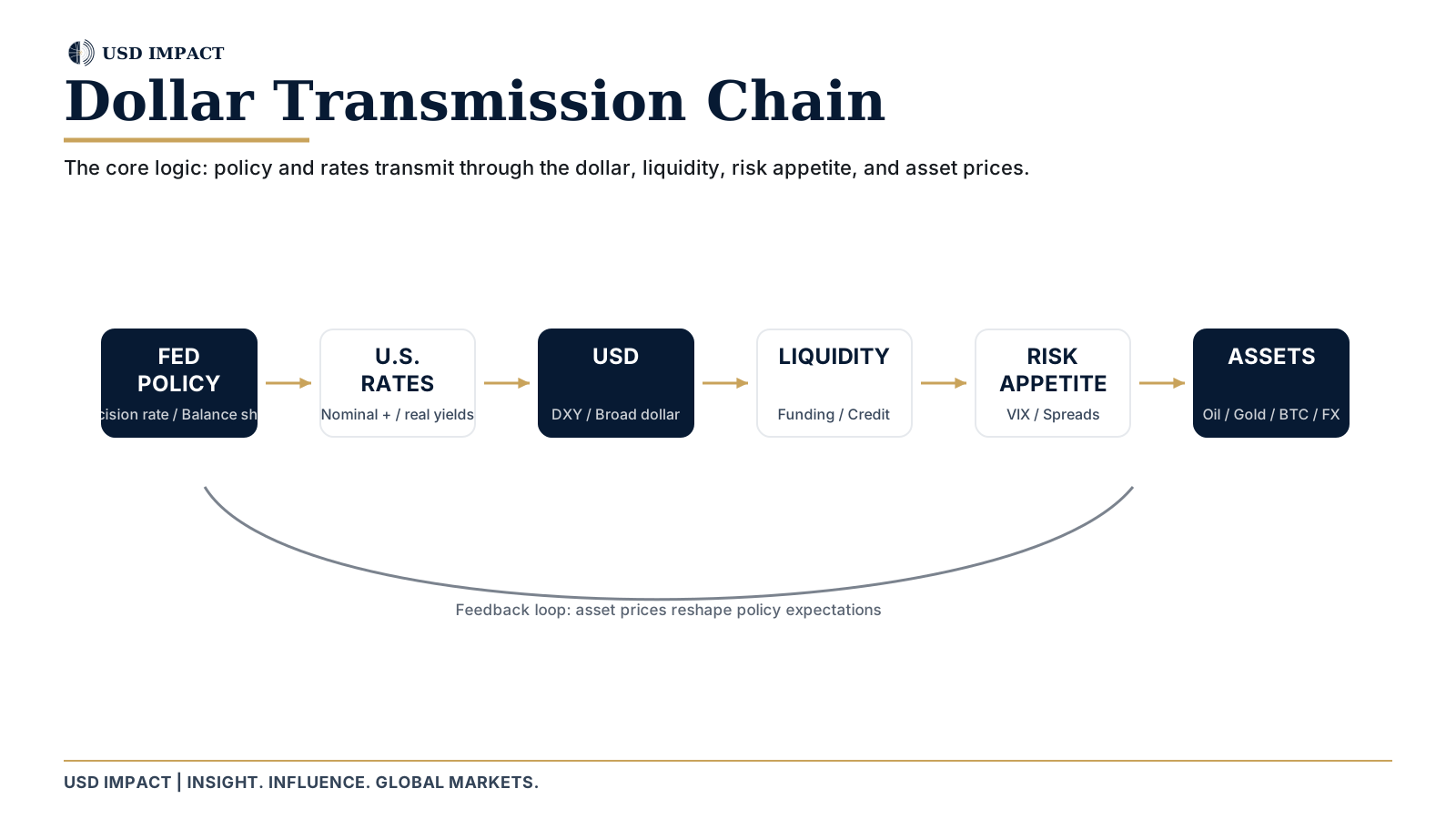
Macro information / policy → rates → dollar and funding → liquidity / risk appetite → cross-asset effects
The arrows can run in both directions. An oil shock can affect inflation expectations and yields. A banking shock can affect dollar funding before monetary policy responds. Geopolitical events can move several assets directly.
Use the Dollar Transmission Chain to test the sequence explicitly.
Weekly monitoring signals
These are reference inputs for situational awareness, not trading signals.
| Framework role | Signal | What to check | Primary / authoritative reference |
|---|---|---|---|
| Dollar direction | DXY | Direction, range and change | ICE-derived market data / market platform |
| Dollar confirmation | Broad Dollar Index | Breadth vs DXY | Federal Reserve / FRED |
| Real-rate pressure | 10Y TIPS yield | Direction and regime | Federal Reserve / FRED |
| Nominal-rate context | U.S. 2Y and 10Y yields | Policy and term-rate pressure | U.S. Treasury / FRED |
| Liquidity stress | Credit spreads | Widening or tightening | FRED / underlying ICE series |
| Liquidity stress | VIX | Volatility/stress confirmation | CBOE |
| Cross-asset confirmation | Gold, oil, equities, Bitcoin | Does behavior support or contradict the proposed mechanism? | Relevant primary exchange/provider data |
A practical reading order
When reviewing a market move:
- Identify the dollar direction.
- Check breadth. Does broader USD evidence confirm DXY?
- Check real rates. Are they reinforcing or contradicting the dollar story?
- Check liquidity stress. Are credit, volatility or funding conditions changing?
- Check cross-asset confirmation. Which assets support the proposed mechanism and which do not?
- Keep unresolved contradictions visible. Do not force every market into one narrative.
For a reusable operating version, open the Three-Dial Macro Dashboard.
Key takeaway
USD Impact uses three macro dials, not four:
Dollar direction → Real-rate pressure → Liquidity stress
Broad USD and cross-asset behavior are confirmation tools inside the framework. They help test whether a proposed explanation is broad, narrow, rate-led, stress-led or mixed.
The framework is useful precisely because it does not promise that one indicator explains every market move.