
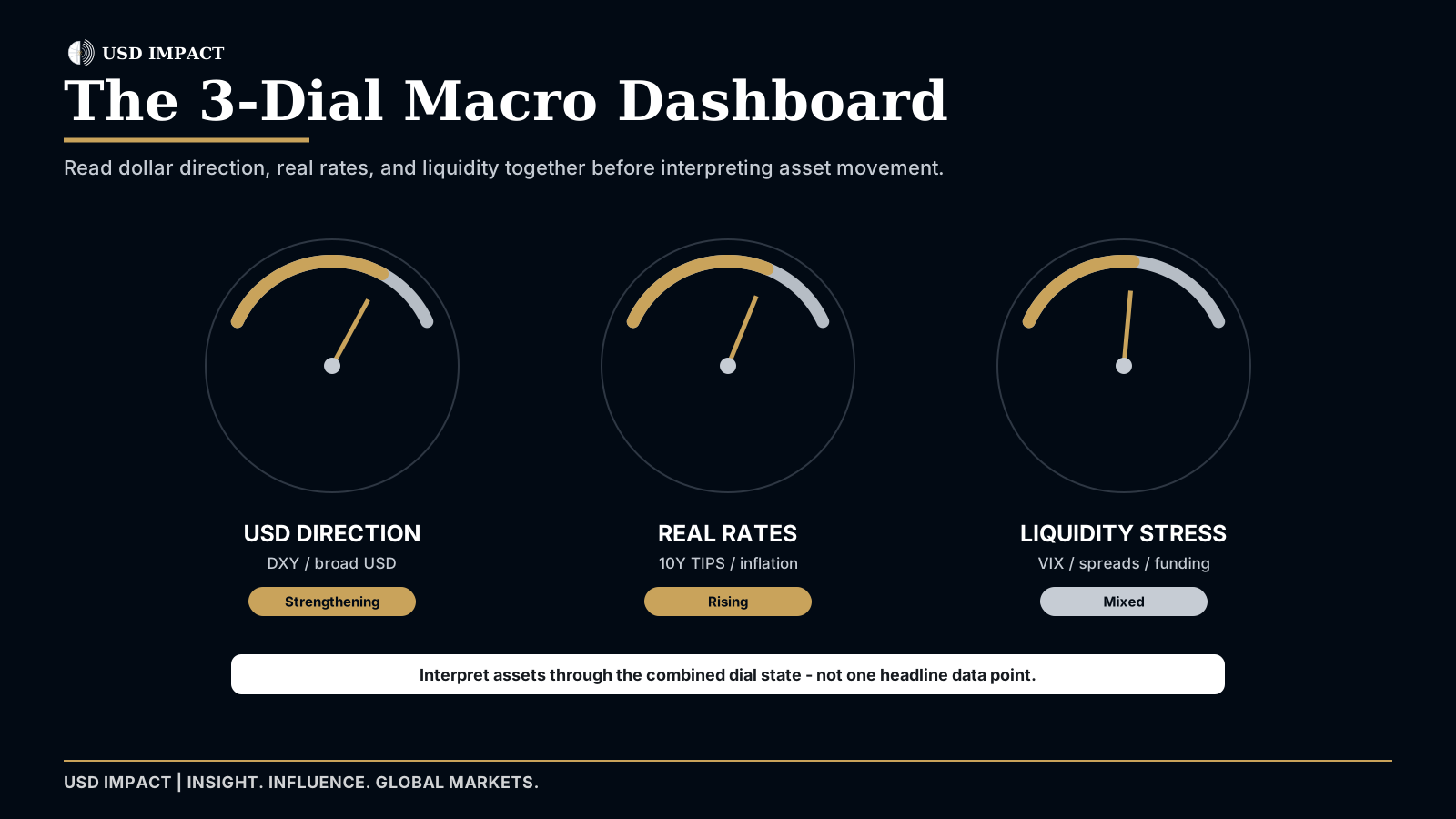
Current Three-Dial reading
firmer
Accessible/reproducible Yahoo Finance proxy for DX-Y.NYB; not represented as exchange-official or a licensed institutional feed.
Federal Reserve H.10 broad-dollar confirmation inside Dial 1; it is not a separate fourth dial.
rising
Tightening / more stress
ICE BofA series displayed through FRED. Only the two observations used by this snapshot are republished.
CBOE VIX displayed through FRED. Only the two observations used by this snapshot are republished.
Derived as SOFR minus IORB (FRED series IORB) in basis points. It is funding context, not a standalone liquidity measure.
Stress-led firm-dollar environment
The completed week showed a firmer DXY reading with confirmed broad-dollar confirmation, 10-year real yields rising, and liquidity stress increased.
Descriptive interpretation of completed observations; not a forecast or trading signal.
USD Impact Score v2
-0.56 · Soft dollar regime · week ending 2026-09-25
Separate descriptive model output. It is not an input to the Three-Dial interpretation and is not a forecast.
Snapshot method, thresholds and source boundaries
Compare the latest usable observation on or before the completed Friday with the latest usable observation on or before the prior Friday. Every fact retains its actual observation date.
Display/interpretation heuristics only. They are not estimated probabilities, optimized trading rules, or inputs to USD Impact Score v2.
- Dated snapshot, not real-time market data. Observation dates are shown for every fact.
- Broad USD is a confirmation layer inside Dial 1, not a fourth dial.
- The SOFR-minus-IORB spread is one funding-context indicator and is not treated as a complete measure of liquidity.
- VIX and ICE BofA High Yield OAS are third-party series accessed through FRED; this snapshot republishes only the two observations needed for the completed-week comparison, not their full histories.
- The Three-Dial interpretation is descriptive and deterministic. It is not investment advice, a trading signal, a probability, or a return forecast.
The purpose of the dashboard
The three-dial dashboard turns the USD Impact framework into a repeatable weekly process.
It is designed to answer one question before you interpret gold, oil, Bitcoin, equities or FX:
What kind of dollar environment are these assets trading inside?
The dashboard does not produce a buy/sell instruction. It records a configuration of observable conditions so that the interpretation can be compared with later evidence.
Dial 1 — Dollar direction
What to record
- DXY direction over the completed observation window;
- whether the move is persistent or mostly intraday noise;
- whether a broader Federal Reserve dollar measure confirms the move;
- whether major FX pairs suggest a broad USD move or a currency-specific story.
Questions to ask
- Is the dollar firmer, softer or broadly rangebound?
- Is breadth confirming DXY?
- Does the move look rate-led, stress-led or driven by foreign-currency developments?
Do not do this
Do not create a separate “fourth dial” for broad USD. Breadth is a confirmation check inside Dial 1.
Dial 2 — Real-rate pressure
What to record
- 10-year TIPS yield direction;
- relevant nominal Treasury yield direction;
- whether real and nominal yields are telling the same story;
- whether the rate move is large enough to matter relative to recent ranges.
Questions to ask
- Are real yields applying more or less valuation pressure?
- Does the rate move support the dollar move?
- Is inflation compensation, rather than real rates, driving the nominal-yield change?
Do not do this
Do not infer real-rate pressure from the nominal 10-year yield alone.
Dial 3 — Liquidity stress
What to record
- credit spreads widening or tightening;
- VIX / volatility direction;
- notable funding-market or banking stress;
- central-bank liquidity operations where relevant;
- whether risk assets show broad stress or isolated weakness.
Questions to ask
- Are markets becoming easier or harder to fund?
- Is dollar strength occurring alongside stress?
- Are credit and volatility confirming a risk-off interpretation?
Do not do this
Do not reduce “liquidity” to one balance-sheet number. Funding, credit and market stress can change even when a central-bank balance sheet is stable.
The weekly worksheet
Use a simple table so the evidence is visible before the narrative is written.
| Dial | Observation | Direction | Confirmation | Confidence |
|---|---|---|---|---|
| Dollar | DXY + broader USD evidence | Firmer / softer / rangebound | Confirmed / mixed / divergent | Low / medium / high |
| Real rates | 10Y TIPS + nominal context | Rising / falling / flat | Reinforces / contradicts dollar | Low / medium / high |
| Liquidity stress | Credit + volatility + funding context | Tightening / easing / mixed | Broad / narrow / unclear | Low / medium / high |
The confidence label is a note about evidence quality, not a probability of future returns.
Convert the observations into a regime description
After recording the dials, summarize the week in one sentence without forecasting.
Examples:
- Rate-led firm-dollar environment: dollar firmer, real yields rising, stress contained.
- Stress-led firm-dollar environment: dollar firmer, real rates mixed, liquidity stress rising.
- Easier soft-dollar environment: dollar softer, real rates falling, stress easing.
- Mixed / transitional environment: the three dials disagree or breadth is weak.
Avoid labels that imply certainty about the next asset move.
Add cross-asset confirmation after the dials
Only after the three-dial reading is written should you check how major assets behaved.
Ask:
- Did gold behave consistently with the real-rate and risk environment?
- Did oil respond mainly to the dollar or to its own supply/demand news?
- Did equities confirm easier/tighter financial conditions?
- Did Bitcoin move with broad liquidity/risk appetite or on crypto-specific drivers?
- Did FX breadth support the DXY interpretation?
Cross-asset behavior can confirm or challenge the macro story. It is not an extra dial.
Worked example
Assume the completed week shows:
- DXY firmer and the broader dollar also firmer;
- 10-year TIPS yield higher;
- credit spreads broadly stable and VIX contained;
- gold softer while equities are mixed.
A disciplined summary could be:
The completed week showed a broadly firmer dollar with higher real-rate pressure but no clear liquidity-stress confirmation, making the configuration more consistent with a rate-led firm-dollar environment than a funding squeeze. Gold weakness was directionally consistent with the rate channel, while mixed equities limited the strength of the cross-asset confirmation.
Notice what this does not say. It does not predict where DXY, gold or equities must move next.
What happens when the dials disagree?
Disagreement is a valid result.
For example:
- DXY firmer;
- real yields falling;
- volatility rising;
- broad USD confirmation mixed.
Do not average this into a false “neutral” conclusion immediately. Instead identify the contradiction and investigate the likely source:
- foreign-currency weakness affecting DXY;
- stress-driven dollar demand;
- asset-specific repricing;
- timing differences between markets.
A mixed configuration can contain more information than a clean label.
How this connects to the rest of USD Impact
Learn cards explain individual concepts such as DXY, real rates and liquidity stress.
Daily USD Impact identifies verified events and the transmission channels they may affect.
The three-dial dashboard organizes the current macro configuration.
The weekly USD Impact Score is a separate systematic cross-asset indicator with a published methodology. It should not be substituted for the three-dial qualitative framework, and the qualitative framework should not be presented as the Score formula.
Weekly Briefs combine the completed week’s sourced developments with the archived Score snapshot and broader interpretation.
This separation keeps educational explanation, external facts and systematic measurement distinct.
A five-minute weekly routine
- Record DXY direction and broad-dollar confirmation.
- Record 10-year TIPS direction and nominal-rate context.
- Record credit/volatility/funding stress direction.
- Write one non-predictive regime sentence.
- Check gold, oil, equities, Bitcoin and FX for confirmation or contradiction.
- Record unresolved contradictions instead of deleting them from the narrative.
- Compare the reading with the published weekly Score without assuming they measure the same thing.
Key takeaway
The dashboard has three dials:
Dollar direction → Real-rate pressure → Liquidity stress
Broad-dollar breadth and cross-asset behavior are confirmation layers. Their purpose is to test the interpretation, not expand the framework into additional dials.
Start with the dials. Then trace the mechanism with the Dollar Transmission Chain.